

Reviewed by the S Reid Roofing Ltd team — last reviewed 2026-09-15
Quick answer
EPDM can offer flexibility and relatively few seams, while modern felt is a proven roofing system with its own advantages. Roof design, edge detailing, penetrations, deck condition and installer competence matter more than choosing a material from its name alone, and either can perform well when correctly specified and installed.
At a glance
- EPDM is typically supplied in large sheets, reducing the number of joints.
- Modern felt systems are multi-layer and have decades of use behind them.
- Both rely heavily on correct detailing at upstands and outlets.
- Installer familiarity with the chosen system affects long-term performance.
What each system offers
EPDM is a single-ply rubber membrane, usually supplied in large sheets, which can reduce the number of joints on a given roof compared with some other systems. It has some tolerance of deck movement because it is flexible rather than rigid, and the material itself does not rely on heat or a curing chemical reaction on site, since sheets are generally bonded with adhesive or mechanically fixed.
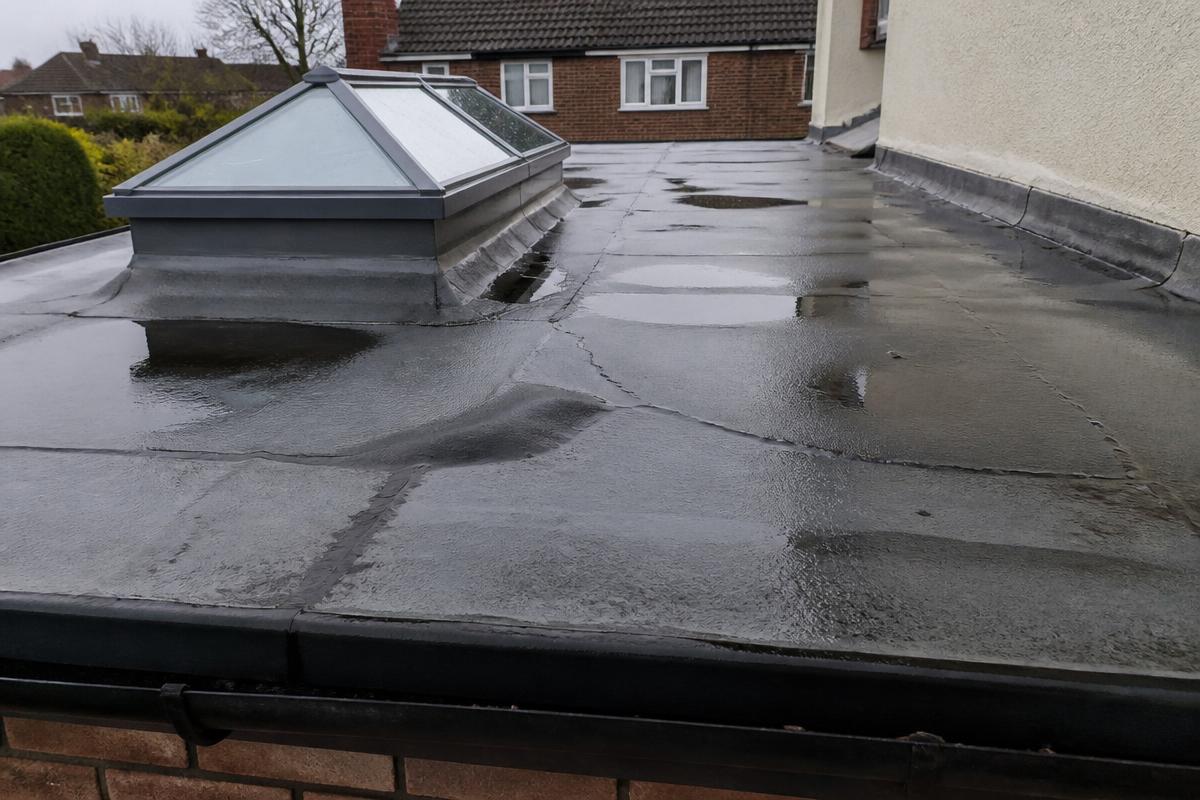
Modern felt is a layered, torch-applied or self-adhesive system that has been used on UK flat roofs for a long time and, correctly installed, gives a durable result. It relies on properly lapped and bonded layers rather than a single continuous sheet, so workmanship at laps and details is central to how it performs. A typical specification uses two or three layers, with the upper layer providing the weathering surface and the lower layers building up thickness and a secondary line of defence against water ingress.
How the two systems age differently
EPDM tends to fail, when it does, at the joints between sheets or at the perimeter where it is dressed into trims and upstands, rather than through the body of the membrane itself, which is generally resilient to UV and weathering over a long service life. Felt is more prone to surface degradation over time, particularly on the top layer where mineral or reflective finishes can wear thin, exposing the bitumen beneath to accelerated ageing from sunlight.
Both systems are affected by standing water if drainage is poor, though the consequences differ slightly: EPDM laps can be undermined by prolonged saturation at a poorly bonded joint, while felt laps can soften and eventually separate under the same conditions. Neither system is designed to sit under permanent standing water, so falls and outlet capacity matter regardless of which covering is chosen.
Why installer competence matters as much as material choice
Both systems fail for similar reasons when they fail: poor detailing at upstands, outlets and penetrations, inadequate falls, or a deck that was not properly prepared before the covering went down. An EPDM roof installed without proper attention to detailing can underperform a well-installed felt roof, and the reverse is equally true.
Choosing between them is better done by looking at the specific roof — its shape, movement, penetrations and expected use — than by treating one material as generally superior. A roof with many small upstands and awkward junctions may favour whichever system the installer has the most practical experience detailing well, since a confidently executed detail in either material will usually outlast an unfamiliar one in the other.
What we would check
During an inspection, areas we would normally look at for this include:
- Roof shape, size and number of upstands or penetrations.
- Deck condition and its tolerance of movement.
- Existing falls and drainage arrangement.
- Condition of any existing covering being replaced.
- Access constraints that might favour one installation method.
Repair, replace or monitor?
Repair
A sound deck with a covering that has only localised damage may only need a local repair regardless of material.
Replace
Widespread seam failure, perished material or a deck no longer able to take fixings usually points to full replacement.
Roof photography
Related questions
Relevant services
Request a roofing quotation
Share what you've noticed and we'll arrange an inspection before recommending works.