

Reviewed by the S Reid Roofing Ltd team — last reviewed 2026-09-15
Quick answer
Neither is universally better. GRP creates a rigid, seamless finish, while EPDM is a flexible membrane suitable for many roof forms. Movement, deck construction, detailing and intended use should determine which system is appropriate for a given roof, and both can give a long service life when correctly specified and fitted.
At a glance
- GRP forms a rigid, fully bonded, seamless surface once laminated.
- EPDM remains flexible and can accommodate some deck movement.
- GRP generally needs a stable, well-fixed deck to perform well.
- Both depend on correct detailing at edges and penetrations.
How the two systems behave differently
GRP (glass-reinforced plastic) is laminated in place and cures into a rigid, seamless surface bonded directly to the deck. That rigidity gives a hard-wearing, fully sealed finish, but it means the deck beneath needs to be stable, because GRP has little tolerance for ongoing movement. Once cured, the laminate and the deck effectively behave as one rigid unit, so any subsequent flexing in the timber tends to show up as cracking in the surface above it.
EPDM is a flexible rubber sheet that can move with a deck to some degree, which suits timber decks that expand and contract with temperature and moisture. It is generally less tolerant of standing surface abrasion in high-traffic areas than a well-laid GRP finish, and repeated foot traffic or dragged furniture on a balcony can wear or score the surface over time in a way a laminated GRP deck resists better.
Installation conditions and practical constraints
GRP application depends on dry conditions and a deck that has been allowed to reach a suitable moisture content, since resin will not cure correctly against damp timber, and trapped moisture beneath a cured laminate can later cause blistering. This makes GRP installation more weather-dependent than EPDM, which can be installed in a slightly wider range of site conditions because it is fitted as a pre-formed sheet rather than mixed and cured on site.
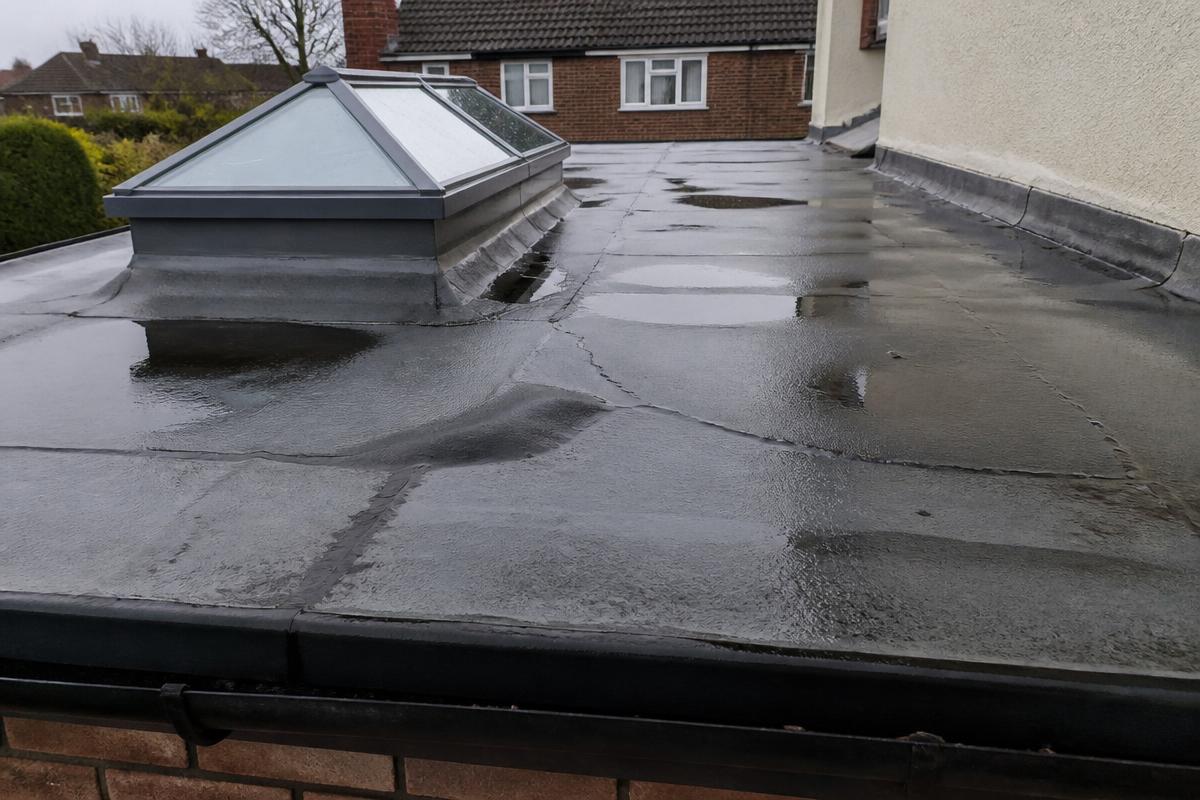
Both systems need mechanical or bonded fixing at the perimeter and around every upstand, kerb, vent pipe and rooflight, and it is at these points, not across the main field of the roof, that most defects eventually appear. A roof with many such penetrations demands careful attention to detailing whichever material is chosen.
Matching the system to the roof
A roof with a stable, well-built deck and complex detailing such as multiple upstands can suit GRP's seamless finish, particularly where the roof will be walked on regularly, such as a balcony or roof terrace. A roof on a more flexible timber deck, or one where large unbroken sheet coverage is an advantage, may suit EPDM better, particularly on larger domestic extensions where minimising joints reduces the number of potential weak points.
Neither answer holds for every roof, which is why the deck and detailing come before the material choice. Ventilation of the roof void also deserves consideration alongside the covering, since trapped moisture within the build-up can affect either system's substrate over time regardless of which finish sits on top.
What we would check
During an inspection, areas we would normally look at for this include:
- Deck construction, fixing and any evidence of flex or movement.
- Number and complexity of upstands, kerbs and penetrations.
- Expected foot traffic or plant loading on the finished surface.
- Existing covering condition where a re-covering is being considered.
- Ventilation and any history of condensation within the roof build-up.
Repair, replace or monitor?
Repair
Surface damage confined to a small area can often be repaired in the same material without full replacement.
Replace
Cracking that follows deck movement, or laminate that has delaminated from the substrate, generally needs replacement rather than a patch.
Roof photography
Related questions
Relevant services
Request a roofing quotation
Share what you've noticed and we'll arrange an inspection before recommending works.