

Reviewed by the S Reid Roofing Ltd team — last reviewed 2026-09-15
Quick answer
Roof life varies greatly with material, workmanship, exposure and maintenance. Some flat-roof systems have a lifespan measured in decades, while quality natural slate can last much longer. Fixings, battens, flashings or detailing may deteriorate before the main covering, so a single figure rarely tells the whole story.
At a glance
- The covering material is only one factor in overall roof life.
- Fixings, battens and flashings often fail before the main covering does.
- Exposure and workmanship influence life as much as the material chosen.
- Ongoing maintenance can extend the useful life of a sound roof.
Why there is no single answer
People often ask how long a roof lasts expecting a single number, but a roof is a system rather than one product. The covering, underlay, battens, fixings, flashings and ventilation all age at different rates, and any one of them can bring forward the point at which work is needed, regardless of how good the covering itself still looks.
Workmanship at the time of installation and any subsequent repairs also has a lasting effect. A well-detailed roof in a sheltered position and a poorly detailed one in an exposed position, built from the same materials, can reach the point of needing attention decades apart. Orientation and shelter matter too: a slope facing prevailing wind and driven rain will generally show wear sooner than one that is more sheltered, even on the same building.
What tends to fail first
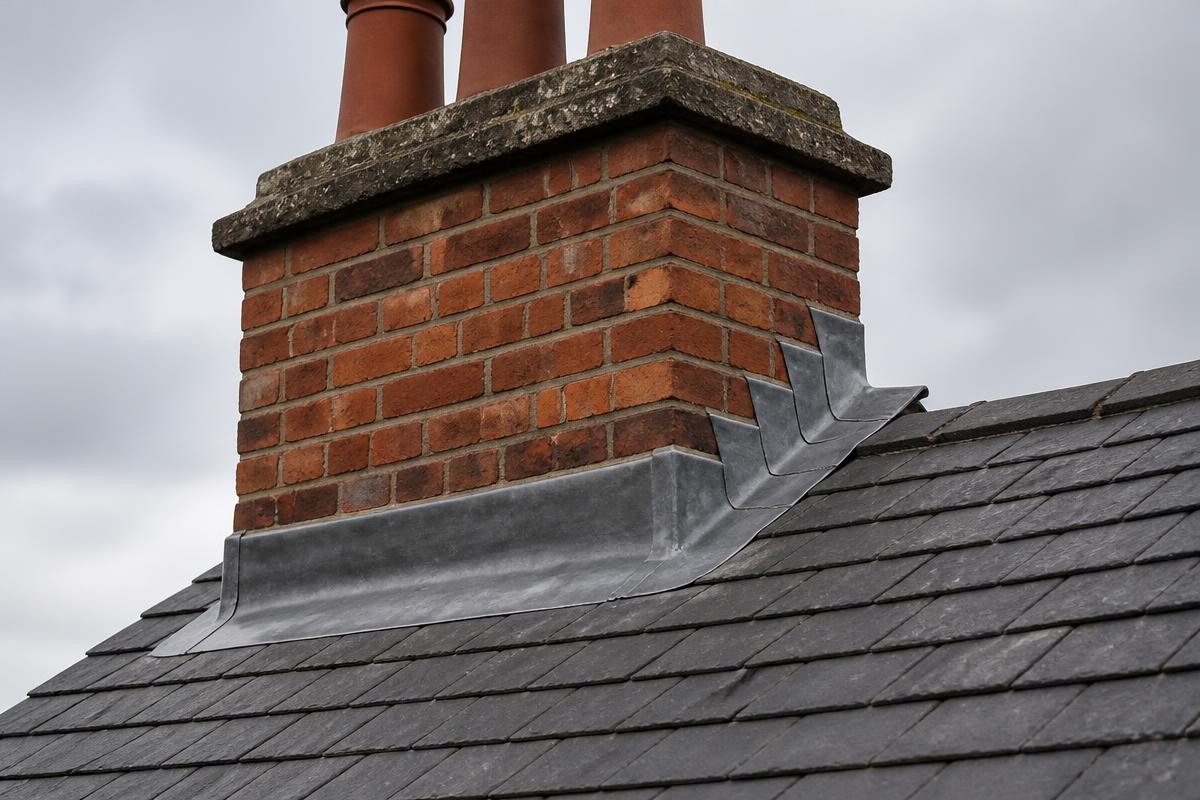
In our experience, it is rarely the main covering that fails first on a well-installed roof. Nails and fixings corrode, battens can decay where moisture has been getting in unnoticed, and flashings or mortar detailing at chimneys and abutments tend to need attention well before a slate, tile or membrane reaches the end of its own working life.
This matters because it changes how a roof should be assessed. Looking only at the visible surface of the covering from ground level can miss the parts of the system that are actually closest to failing. A proper inspection needs to consider what is happening beneath the surface, in the loft, and at the junctions, not just the general appearance of the slopes.
- Fixings and nails, particularly on older slate and tile roofs.
- Battens, where trapped moisture has caused gradual decay.
- Flashings, soakers and mortar fillets at junctions and chimneys.
- Underlay, especially early bitumen felts that become brittle with age.
How maintenance and exposure change the picture
Two roofs built at the same time, with the same materials, can age at noticeably different rates depending on how they have been looked after. A roof where displaced coverings were dealt with promptly, gutters kept clear and chimney detailing checked periodically will generally reach a given condition later than one left unattended, even though both started from the same point.
Exposure is the other major variable. Sites that take significant wind-driven rain, or that sit at altitude or close to the coast, put more stress on fixings and flashings than sheltered, low-lying positions. This is one reason why a roof of a given age on an exposed hillside in north Cumbria may need attention sooner than a similar roof in a more sheltered spot, even though the covering material and original installation were comparable.
Because of all this, the more useful question is usually not how long a roof lasts in the abstract, but what condition this particular roof is in now, and what its most vulnerable components are likely to need over the coming years.
What we would check
During an inspection, areas we would normally look at for this include:
- The condition of the covering itself, slope by slope.
- Fixings and battens where these can be safely assessed.
- Flashings, valleys and any mortar detailing at junctions.
- Evidence of previous repairs and how they were carried out.
- Ventilation and any signs of trapped moisture in the roof space.
Repair, replace or monitor?
Repair
Where the covering is sound and only isolated details have failed, targeted repair is usually appropriate.
Replace
Where fixings, battens or underlay have failed broadly across a slope, repeated repair stops being economic.
Monitor
A roof with no active defects can often be checked periodically rather than worked on.
Roof photography
Related questions
Relevant services
Book a roof inspection or drone survey
Documented findings before any repair is quoted. Suitable for pre-purchase checks, storm-event assessment and inaccessible roofs.