

Reviewed by the S Reid Roofing Ltd team — last reviewed 2026-09-15
Quick answer
A local repair can make sense when the surrounding covering and roof deck remain sound. Replacement becomes more likely when deterioration is widespread, the deck is damaged, ponding is persistent or repeated repairs are failing in different places, so the extent of the problem should be established before either option is decided on.
At a glance
- A sound surrounding covering is the main condition for a repair to be worthwhile.
- Deck damage usually means the covering above it cannot simply be patched.
- Persistent ponding shortens the life of any repair carried out around it.
- Repairs failing in new locations suggest the whole covering is ageing.
When repair is a reasonable option
Where a leak or defect is confined to a specific detail — a split seam, a damaged trim, a puncture — and the covering elsewhere is still flexible and well bonded, repairing that one area is usually the sensible first step. There is no reason to replace a whole roof because one detail has failed if the rest of the system is performing as it should.
A repair carried out in the same material as the existing covering, by someone familiar with that system, generally bonds and weathers more predictably than a mismatched material introduced as a quick fix. Where the original material can no longer be reliably matched or sourced, that is itself worth factoring into the repair-versus-replace decision.
When replacement becomes the more realistic option
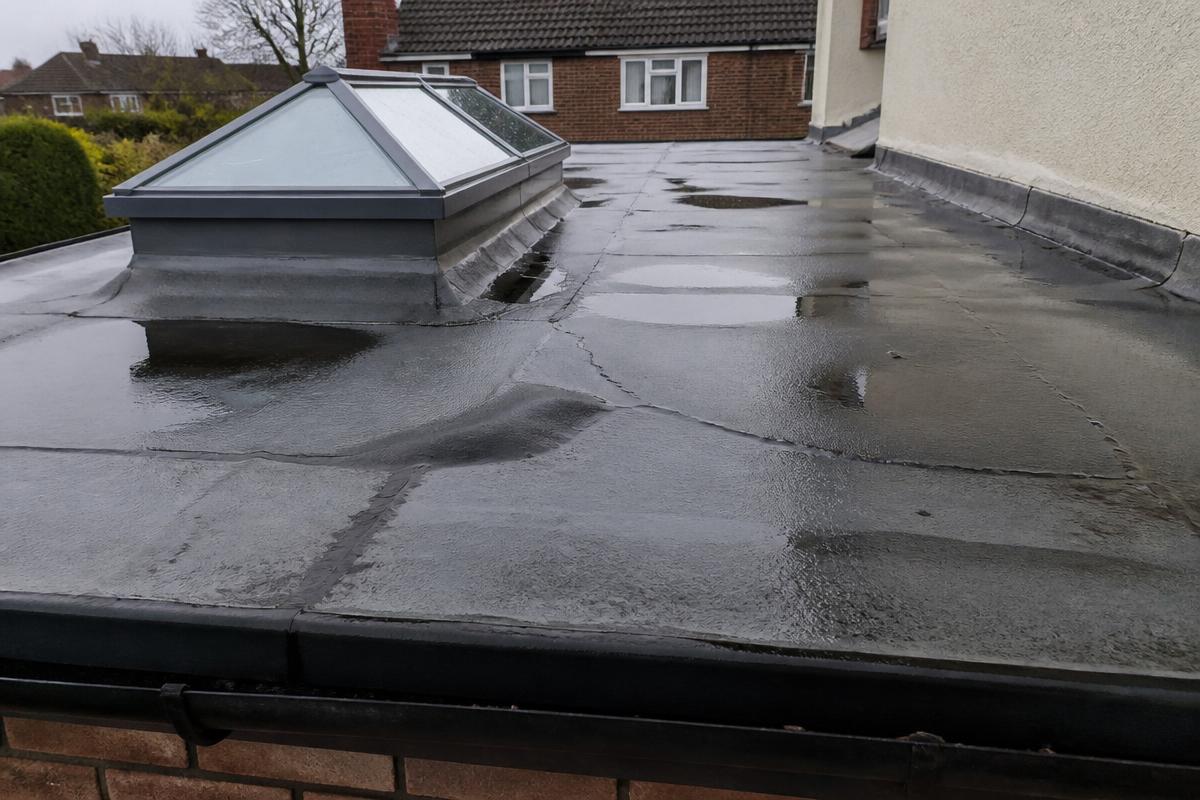
Once deterioration is found across several areas rather than one, or the deck itself is soft, delaminated or damp, a repair has little sound material to bond to and is unlikely to last. Persistent ponding also works against repairs, because standing water keeps stressing exactly the details a repair depends on. In these situations, repeated patching becomes a series of short-term fixes rather than a lasting solution.
Age is a related consideration. Felt, GRP and EPDM all have a typical useful life, and a covering already well into that range is statistically more likely to develop a further defect soon after a repair than a covering only a few years old. That does not make repair wrong in every case, but it does mean the remaining service life of the whole roof is a reasonable factor to weigh alongside the cost and disruption of each option.
- Deterioration confined to one area with a sound surrounding covering: repair.
- Deck damage, widespread ageing or repeated new-location leaks: replacement.
- Persistent ponding around the defect: investigate drainage before repairing.
Why the deck often decides the outcome
Whatever the covering, it can only perform as well as the structure beneath it. A deck that has taken on moisture over time, whether through a slow leak or condensation within the roof build-up, loses strength and its ability to hold fixings securely. Laying a new repair, or even a whole new covering, over a compromised deck without addressing the deck itself tends to produce an early repeat failure, so deck condition is usually the first thing worth establishing before committing to either option.
Disruption and access are practical, rather than technical, considerations, but they are still worth weighing. A repair can often be carried out in a single short visit with minimal disturbance, whereas a full re-covering typically needs the existing surface stripped back, which affects timing and access to the building beneath, particularly on an occupied extension roof or a roof over a working space.
What we would check
During an inspection, areas we would normally look at for this include:
- Extent of the defect and condition of the surrounding covering.
- Deck condition, including any soft spots or signs of moisture ingress.
- History of previous repairs and whether they have held.
- Falls and drainage, and whether ponding contributed to the defect.
- Remaining expected service life of the covering as a whole.
Repair, replace or monitor?
Repair
Isolated defects with a sound surrounding covering and deck are normally repairable.
Replace
Deck damage, widespread deterioration or repeated failures in different places point to replacement being more durable than continued patching.
Monitor
A covering that is ageing but still watertight, with no active leak, can often be reviewed rather than worked on immediately.
Roof photography
Related questions
Relevant services
Book a roof inspection or drone survey
Documented findings before any repair is quoted. Suitable for pre-purchase checks, storm-event assessment and inaccessible roofs.