

Reviewed by the S Reid Roofing Ltd team — last reviewed 2026-09-15
Quick answer
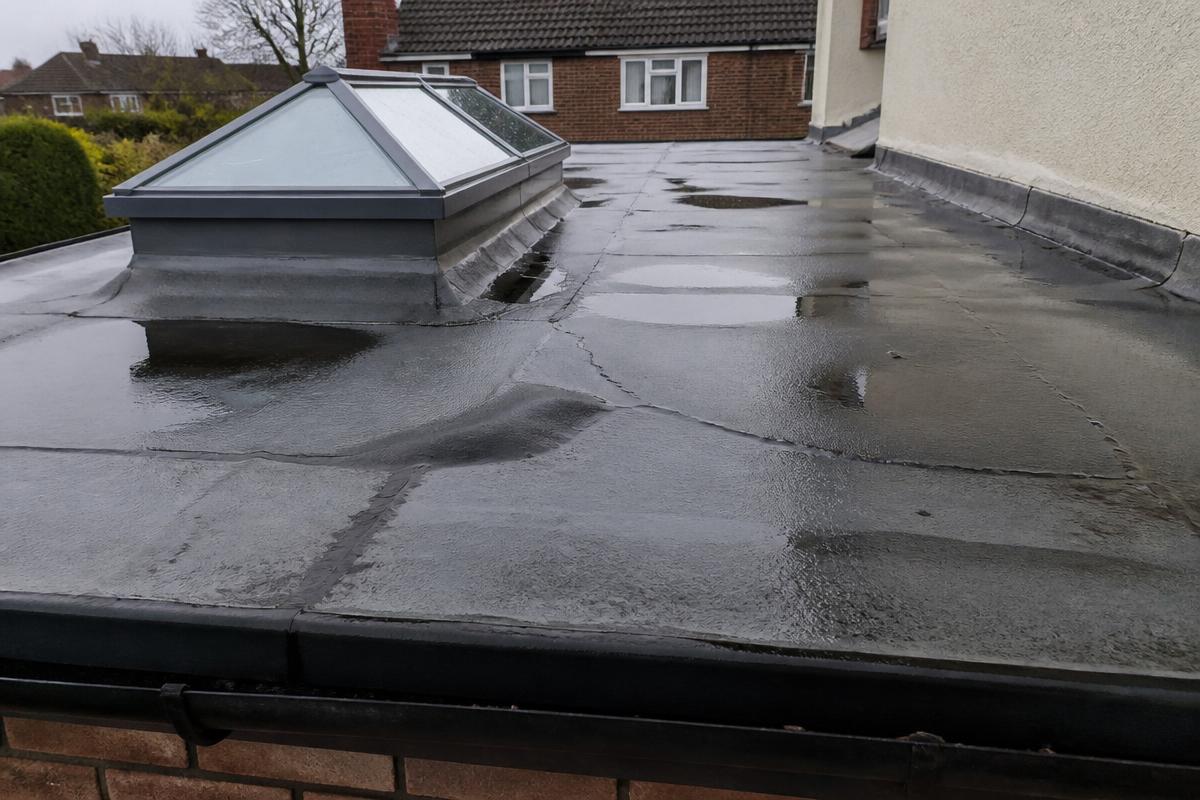
Small amounts may remain briefly after rainfall, but persistent ponding can indicate poor falls, blocked drainage or deformation in the roof structure or deck. If water consistently remains long after surrounding areas have dried, the roof and its drainage arrangement should be assessed rather than assumed to be a normal feature.
At a glance
- A flat roof still has a fall, and water should clear within a short period.
- Ponding that lasts more than a day or two after rain is worth investigating.
- Ponding accelerates ageing at seams, laps and coatings sitting beneath it.
- The cause may be drainage, falls, or deck deformation, and these need different remedies.
Why a small amount of standing water is not unusual
Flat roofs are built with a shallow fall rather than being perfectly level, but manufacturing and construction tolerances mean a small residual puddle immediately after heavy rain is common and not necessarily a fault. The distinction that matters is how long the water takes to clear once the rain has stopped, and how consistent that pattern is across different weather events rather than one unusually heavy downpour.
When ponding points to a genuine problem
Water that is still sitting a day or more after rain, in the same spot every time, usually means the fall in that area has been lost, an outlet is restricted, or the deck has deflected slightly to create a low point. Any of these will keep directing water to the same place, and coverings are not designed to sit permanently submerged, so seams and laps in that area age faster than the rest of the roof.
On timber-decked roofs, a low point that develops gradually over several years is often a sign that a joist or bearer has begun to sag under long-term load, sometimes made worse by the additional weight of the ponded water itself, which creates a self-reinforcing cycle: the low spot collects more water, which adds weight, which deepens the low spot further.
A blocked or undersized outlet is worth ruling out early, since it is the simplest cause to fix and the easiest to overlook. Leaves, moss and wind-blown debris collect around outlets in exactly the low points where ponding also occurs, so it can be difficult to tell by eye alone whether the outlet is restricting flow or whether the fall itself has failed until the outlet has been cleared and the area watched again after rain.
What consistently sitting water does to a covering over time
Bitumen-based felt exposed to prolonged saturation can soften at laps, allowing water to work its way beneath the top layer even where the surface itself remains intact. EPDM is more resistant to water absorption through the membrane body, but a poorly bonded joint sitting permanently underwater is more likely to fail than the same joint only briefly wetted. GRP laminate is generally the most tolerant of standing water on the surface, provided the laminate itself has no existing cracks or pinholes for water to track through to the deck below.
Algae and organic growth can also establish in areas of persistent ponding, particularly on north-facing or shaded roof areas that dry more slowly, and while this is mostly a cosmetic issue in the short term, it can mask the early signs of surface deterioration underneath.
What we would check
During an inspection, areas we would normally look at for this include:
- How long water takes to clear after rainfall in the affected area.
- Falls across the roof and whether a low spot has developed.
- Outlet and downpipe condition for restrictions.
- Deck condition beneath any persistent ponding area.
- Covering condition specifically within the ponded area.
Repair, replace or monitor?
Repair
A blocked outlet or a localised low spot can sometimes be corrected without wider work.
Replace
Deck deflection causing persistent ponding across a wider area may need re-decking or tapered insulation as part of a re-covering.
Monitor
Minor, short-lived residual water that clears within a day or so after rain is not usually a cause for concern.
Roof photography
Related questions
Relevant services
Book a roof inspection or drone survey
Documented findings before any repair is quoted. Suitable for pre-purchase checks, storm-event assessment and inaccessible roofs.