

Reviewed by the S Reid Roofing Ltd team — last reviewed 2026-09-15
Quick answer
Roof repair prices vary because replacing one damaged slate is very different from rebuilding a valley, renewing leadwork or repairing damaged timber. Access, roof height, materials, labour, scaffolding and hidden deterioration all affect the quotation, so diagnosis should come before an exact price.
At a glance
- Two jobs that look similar from the ground can involve very different work once opened up.
- Access and height affect cost as much as the repair itself.
- Hidden decay found once a covering is lifted changes the scope, not just the price.
- A written scope of works is what a quotation should actually be pricing.
Why one figure cannot cover every repair
A roof repair is not one product with a fixed price, it is a description of work that follows from what has actually failed. Refitting a single displaced slate on an easily accessible slope is a different job from renewing a valley gutter, rebuilding a chimney flashing, or replacing decayed timber discovered once a covering is lifted. Each of these calls for different materials, different time on the roof and, often, a different means of getting up there safely.
This is why we would rather describe the drivers of cost than offer a figure that cannot honestly apply to every roof. The variables below are the ones that genuinely move a quotation up or down, and they interact with each other rather than acting in isolation. A roof that is easy to reach but has widespread nail sickness across the slating, for example, may still involve a substantial scope even though access is straightforward.
It is also worth separating the cost of the visible repair from the cost of establishing what the repair actually needs to be. Diagnosis takes time and skill in its own right, particularly on older roofs in north Cumbria where slate sizes, fixing methods and underlay specifications can vary considerably from one property to the next, and sometimes from one slope to another on the same roof.
What actually drives the price
Several factors combine on every job, and the balance between them is different each time. None of them can sensibly be priced from a description over the phone.
- The extent of the defect — one slipped tile versus a run of failed fixings across a slope.
- Access and height — a single-storey outbuilding is not priced the same as a steep three-storey slope.
- Whether scaffolding, towers or rope access is needed to work safely.
- The materials involved — matching an existing slate or lead detail can take longer than a standard replacement.
- Condition found once the covering is opened up — sound battens and underlay keep a job small, decay extends it.
- Weather exposure of the property, since roofs on exposed fell or coastal sites tend to show more general wear alongside a specific defect.
Why we quote after inspection
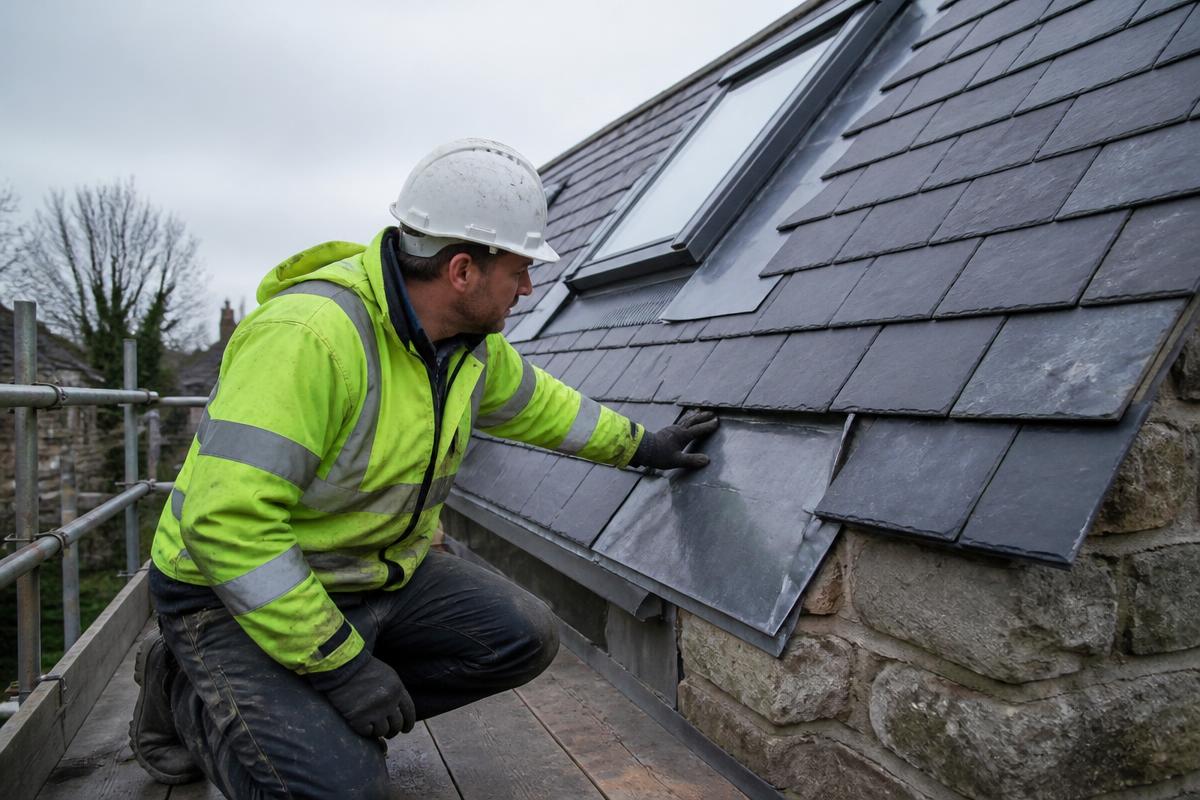
A price given before anyone has seen the roof is a guess dressed up as a quotation. We would rather inspect first, record what we find with photographs, and set out a scope of works that explains what is being priced and why. That way the figure you are given relates to your roof, not to an assumed average job.
This also protects you from two opposite risks. The first is a quotation that looks attractive because it has not accounted for likely additional work, and then grows once the roof is opened up. The second is a quotation padded to cover for uncertainty the contractor has not bothered to resolve by inspecting properly. A scope of works agreed in advance, with clear notes on what happens if further deterioration is found, avoids both.
What we would check
During an inspection, areas we would normally look at for this include:
- The extent of the defect and whether it repeats elsewhere on the slope.
- Safe access options for the height and pitch involved.
- Fixings, battens and underlay condition around the affected area.
- Matching materials required against what is already on the roof.
- Any related detailing — flashings, valleys, ridges — that may be part of the same cause.
Repair, replace or monitor?
Repair
Where the defect is isolated and surrounding materials are sound, the scope stays small.
Replace
Where the same failure recurs across a slope, repeated small repairs can become less economic than addressing the slope as a whole.
Monitor
Stable, cosmetic issues with no water ingress can sometimes be recorded and reviewed rather than priced immediately.
Roof photography
Related questions
Relevant services
Request a roofing quotation
Share what you've noticed and we'll arrange an inspection before recommending works.