

Reviewed by the S Reid Roofing Ltd team — last reviewed 2026-09-15
Quick answer
No. The safe access method depends on the height, pitch, duration and type of work involved. A drone may sometimes provide a useful initial visual assessment without scaffolding, but carrying out the repair itself can still require appropriate, properly arranged physical access to the roof.
At a glance
- Low or single-storey roofs can often be repaired safely without scaffolding.
- Height, pitch and duration of the job all affect the access decision.
- A drone survey and a physical repair are two separate stages with different access needs.
- Scaffolding is a safety decision first, and a cost factor second.
A drone survey documents what is visible: covering condition, flashings, chimneys, gutters and rainwater goods. It cannot see concealed timber decay, hidden membrane or fixing failure, every source of water ingress, or confirm structural adequacy — where those are suspected, a hands-on inspection is recommended alongside the imagery.
What decides whether scaffolding is needed
There is no fixed rule that every repair needs scaffolding, and no fixed rule that none do. The decision follows from the height and pitch of the roof, how long the work will take, and whether the task can be carried out safely using a ladder, tower or roof ladder instead. A short repair on a low, gently pitched roof may not need it. A longer job on a steep or high roof, or one where a roofer needs to move around freely to check adjoining areas, usually will.
The Work at Height Regulations require whoever is carrying out the work to select equipment appropriate to the task rather than defaulting to the cheapest option, and this is the framework a competent contractor should be working within when deciding on access. That means the decision is made on safety grounds first, with cost following from it, rather than the other way round.
Where a drone fits into this
A drone can provide a useful initial visual assessment of a roof from a distance, which can help establish the general scope of a problem without anyone going up. This can be particularly useful for a first look at a high or steep roof, or for checking areas that are otherwise difficult to see clearly from the ground.
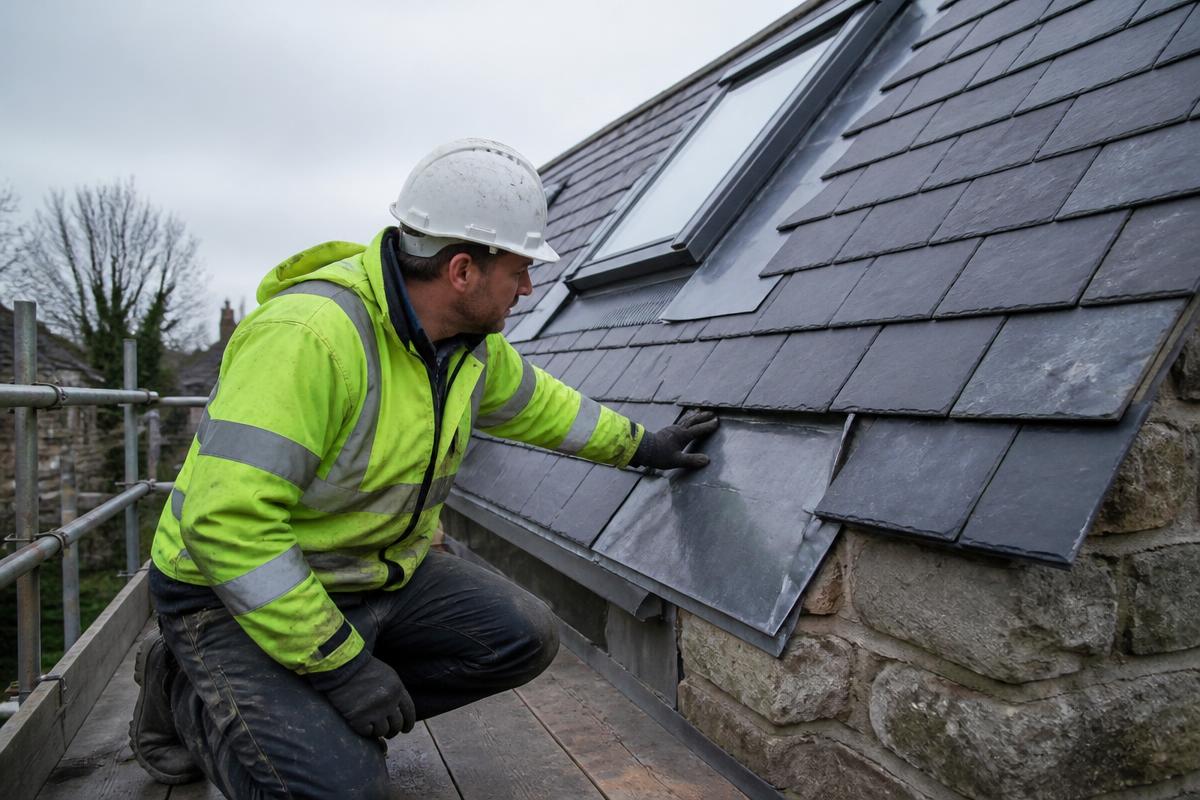
What it cannot do is replace the physical access needed once repair work is agreed — a drone cannot lift a slate, refix a batten or renew a section of leadwork. It is a diagnostic step, not a substitute for the repair itself, and it also cannot confirm the condition of timber, membrane or fixings hidden beneath the covering. A drone image can show a slipped slate or a cracked ridge from the outside, but it cannot tell you whether the underlay behind it has failed or whether the batten holding the next slate along is sound. Those things can only be established once someone has physical access to lift and check the covering directly.
Weighing up towers, ladders and scaffolding
Where scaffolding is not strictly necessary, other options such as a mobile tower or properly footed ladder can sometimes provide safe access for a shorter, well-defined repair. These tend to be quicker to set up and take down than a full scaffold, which can suit an isolated repair on part of a roof. Full scaffolding becomes the more sensible option where the job will take several days, where several trades need access, or where the roof pitch or condition of the surrounding fabric makes ladder access unsuitable.
What we would check
During an inspection, areas we would normally look at for this include:
- The height and pitch of the roof against safe ladder-access limits.
- How long the repair is likely to take and whether that changes the access method.
- Whether the area needing repair is reachable without full scaffolding.
- Whether an initial drone assessment would usefully inform the scope before committing to access.
Roof photography
Related questions
Relevant services
Book a roof inspection or drone survey
Documented findings before any repair is quoted. Suitable for pre-purchase checks, storm-event assessment and inaccessible roofs.