

Reviewed by the S Reid Roofing Ltd team — last reviewed 2026-09-15
Quick answer
Roof repair pricing includes more than the visible replacement part. Diagnosis, skilled labour, travel, equipment, insurance and safe access all contribute. On high or difficult roofs, safely reaching a relatively small defect may represent a significant part of the job.
At a glance
- A quotation covers the visit, not only the visible repair.
- Safe access has to be arranged whether the defect is large or small.
- Skilled labour and appropriate insurance sit behind every job, however brief.
- A quick-looking repair can still require the same setup as a larger one.
The parts of a job that are not visible in the price
It is a reasonable question: if the defect is small, why does the invoice not feel small too? The answer is that a roof repair quotation is pricing the whole visit, not just the piece of material that is replaced. Diagnosing the defect properly, getting a competent roofer safely onto the roof, the equipment needed to do that, and the insurance and training that stand behind the work are all part of what is being paid for, whether the job takes ten minutes or a full day.
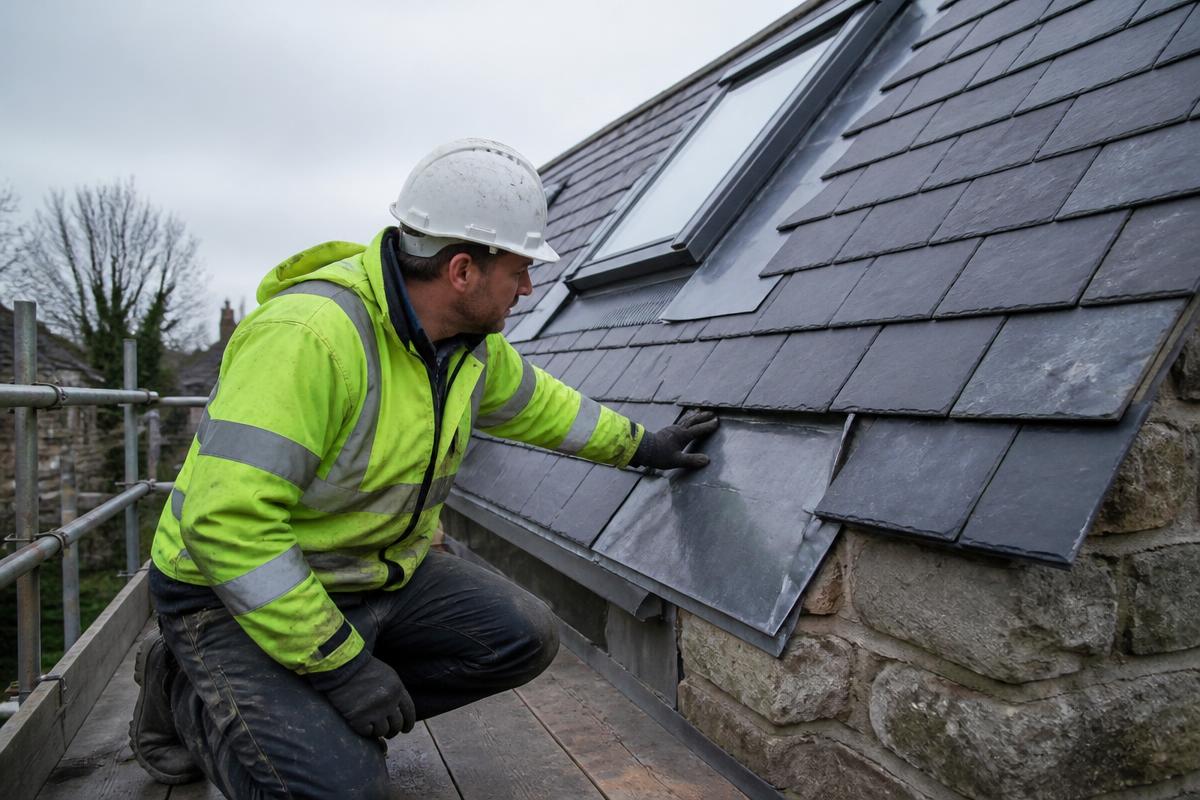
None of this changes because the visible defect happens to be small. A single loose ridge tile at height can require exactly the same access arrangements as a much larger repair. A roofer working at height also needs time to check the immediate surroundings of the defect properly rather than simply swapping one piece and coming straight back down, since a repair carried out in isolation without checking adjoining fixings can fail again quickly.
Why access is often the deciding factor
On a roof that is low, gently pitched and easily reached, a small repair can genuinely be a small job. On a steep, high or awkward roof, reaching that same small defect safely can take as long as, or longer than, carrying out the repair itself once there. Where scaffolding or additional equipment is genuinely needed for safety, that cost applies regardless of how minor the defect turns out to be once reached.
Travel and scheduling also play a part, particularly across a rural area like north Cumbria and south west Scotland where properties can be spread well apart. A short repair at a distant property still needs the same vehicle, tools and time allowed for the round trip as a longer job closer to base, and this is reflected in how call-outs for small, isolated repairs tend to be priced.
When it is worth combining work
Where a small defect is found during a wider inspection, or where a second minor issue is noticed once someone is already safely on the roof, it is often more sensible to deal with both during the same visit rather than arranging access twice. This is not about adding unnecessary work, but about making reasonable use of the access already set up, and it is something worth discussing before the visit if you are aware of more than one issue.
It is also worth being wary of the reverse assumption, that a low quoted figure necessarily means a corner has been cut. A genuinely small, easily reached repair with no complicating factors can be priced modestly precisely because none of the harder variables apply, and a low price on that basis is not in itself a cause for concern.
What we would check
During an inspection, areas we would normally look at for this include:
- The height, pitch and general accessibility of the affected area.
- Whether the defect can be safely reached with a ladder or requires additional equipment.
- Whether other issues can reasonably be addressed during the same visit.
- The time realistically needed to diagnose as well as carry out the repair.
Repair, replace or monitor?
Repair
Most single, well-defined defects remain straightforward repairs once access is accounted for.
Roof photography
Related questions
Relevant services
Request a roofing quotation
Share what you've noticed and we'll arrange an inspection before recommending works.