

Reviewed by the S Reid Roofing Ltd team — last reviewed 2026-09-15
Quick answer
There is no reliable single price for a roof leak because the damp patch does not identify the repair required. A displaced covering may be simple to put right, while defective leadwork, damaged valleys, saturated decking or structural deterioration can involve substantially more time and materials.
At a glance
- The location of a ceiling stain rarely matches the location of the fault.
- Water can travel along timbers before it appears indoors.
- The repair needed depends on the source, not the symptom.
- An inspection is what turns a guess into a scope of works.
Why the symptom cannot be priced on its own
A leak is evidence that water has found a route in somewhere, but the ceiling mark or damp patch tells you where the water ended up, not necessarily where it entered. Water can travel along a rafter, run down a wall plate, or track along the underside of an underlay before it becomes visible indoors. Pricing a repair from the visible symptom alone risks pricing the wrong job entirely.
This is why leak repairs vary so widely in scope. Sometimes the cause is a single displaced slate that is quick to put right. On other occasions the source is failed leadwork, a defective valley, saturated decking or timber that has been decaying quietly for some time, each of which involves considerably more work than the first.
Weather also plays a part in how a leak presents. During prolonged heavy rain, wind-driven water can be forced past a detail that copes perfectly well in normal conditions, which can make an intermittent leak harder to pin down than a constant one. A single dry visit is not always enough to see the fault in action, and sometimes the pattern of staining over more than one wet spell has to be considered alongside a physical inspection.
What changes the scope once the cause is found
Once the entry point is traced, the wider question is how much surrounding material has been affected by the water that has already got in. Underlay that has been wet for a long period may have perished, battens can soften, and timber can show signs of decay well beyond the immediate area of the leak. The longer a leak has been running unnoticed, typically over more than one wet season, the more likely it is that the repair extends beyond the original point of entry.
- Whether the fault is a single displaced component or a failed detail such as a valley or flashing.
- How far water has travelled before finding its way indoors.
- Whether underlay, battens or timber have been affected by prolonged dampness.
- Access needed to reach and repair the point of entry safely.
- Whether the leak has been intermittent, which can mean it needs observing under the right weather conditions before it can be confirmed as resolved.
Repair, replace or wait and see
A single traced source with sound surrounding materials is generally a contained repair. Where the leak has been running for some time, or where several separate sources are found feeding into the same area of staining, the more economic answer can shift towards addressing a wider section of the covering rather than patching each source in turn. Deciding between these options is a matter of inspecting the extent of the damage rather than guessing from the size of the ceiling mark.
What we would check
During an inspection, areas we would normally look at for this include:
- The loft, tracing staining and damp timber back towards its likely source.
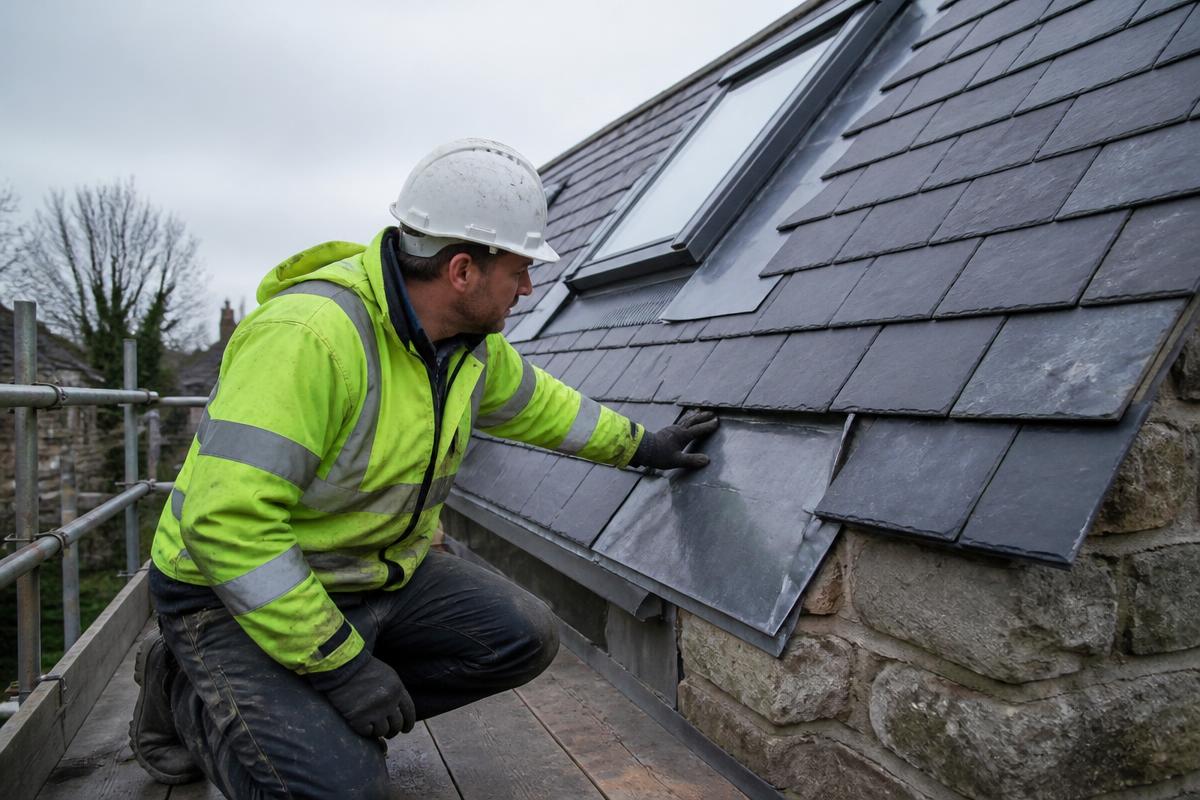
- The roof covering, flashings and valleys above and around the affected area.
- Underlay and batten condition where water has clearly been present.
- Whether the pattern of staining suggests one source or several.
Repair, replace or monitor?
Repair
A traced, isolated source with sound surrounding materials is usually a straightforward repair.
Replace
Extensive decay or repeated leak sources across the same slope may mean the covering needs wider attention.
Monitor
A resolved historic stain with no ongoing dampness can often simply be watched after the repair.
Roof photography
Related questions
Relevant services
Book a roof inspection or drone survey
Documented findings before any repair is quoted. Suitable for pre-purchase checks, storm-event assessment and inaccessible roofs.