

Reviewed by the S Reid Roofing Ltd team — last reviewed 2026-09-15
Quick answer
Home insurance generally does not exist to fund ordinary roof ageing or maintenance. Coverage may apply where an insured event causes damage, but policy wording and the insurer's assessment determine the outcome. An honest, evidenced account of the roof's condition can help that conversation, though we cannot advise on what a specific policy will or will not pay.
At a glance
- Wear and tear sits outside what buildings insurance is generally intended to cover.
- A single storm can still trigger a claim on an otherwise ageing roof.
- The insurer, not the roofer, decides how a specific policy applies.
- An inspection can describe condition; it cannot promise an outcome.
The general distinction insurers draw
Buildings insurance is typically intended to respond to sudden, identifiable events rather than the gradual process of a roof reaching the end of its working life. A covering that has slowly deteriorated over many years through weathering, lack of maintenance or age is generally treated differently from damage caused by an isolated, severe event.
This means an old roof is not automatically excluded, and a well-maintained roof is not automatically covered — the assessment turns on cause, not simply on age or condition at the time of the claim. A twenty-year-old roof that suffers a genuine storm event can still have a legitimate claim; a five-year-old roof with a poorly executed detail that has failed slowly may not.
How age and neglect show up on inspection
An older roof that has simply reached the end of its service life tends to show consistent signs across most of its surface: fixings that have corroded evenly, slates or tiles that have become porous or laminated throughout rather than in one place, and underlay that has visibly perished where it can be seen from the loft. Leaks in this situation often appear in more than one location, or move around depending on wind direction and rainfall intensity.
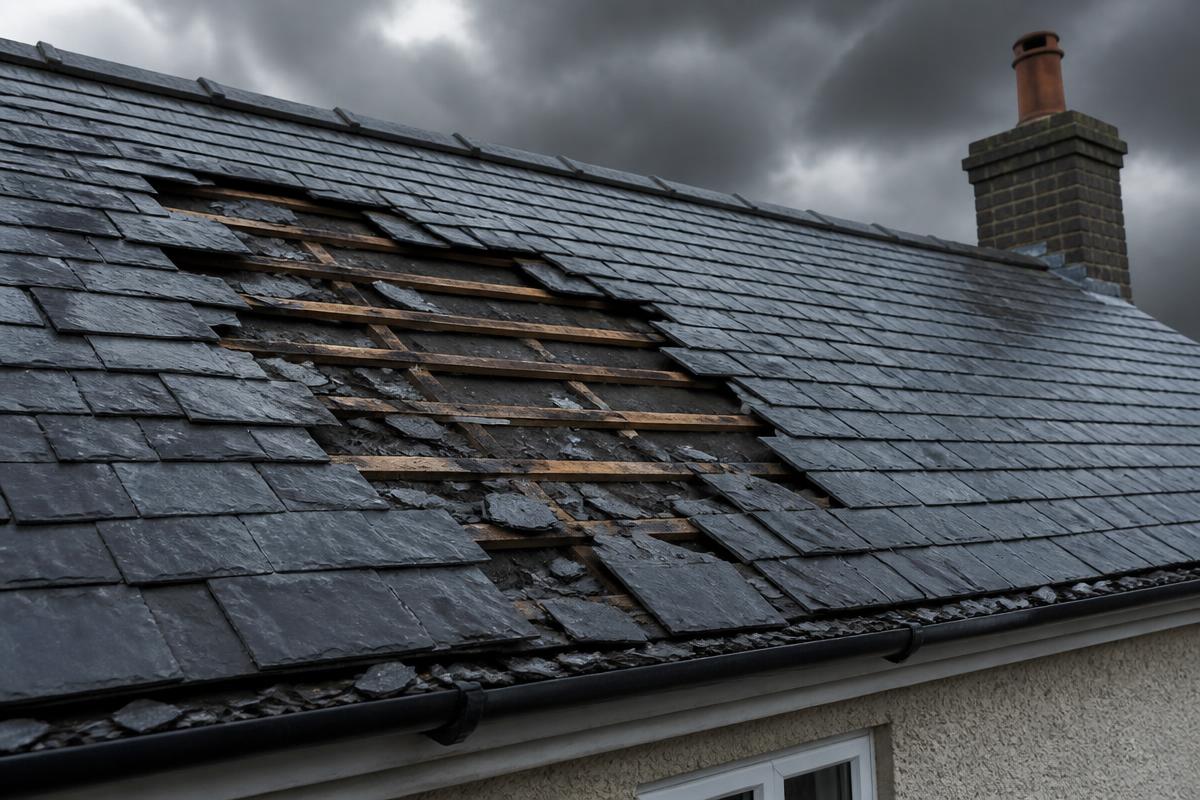
By contrast, damage from a specific event tends to be localised, with a clear point of failure surrounded by coverings and fixings that are otherwise in reasonable condition for their age. This does not remove the need for maintenance elsewhere, but it does help describe what happened in a way an insurer can weigh up.
What maintenance history is worth keeping
Where a homeowner has had periodic checks, gutter clearances or minor repairs carried out over the years, keeping a simple record of dates and what was done can support a claim by showing the roof was not neglected. It cannot turn genuine wear and tear into an insured event, but it can help rule out lack of maintenance as the explanation for a specific failure.
If no such record exists, that is common and does not automatically count against a claim — insurers assess the roof as found, and an inspection report describing genuine current condition carries more weight than the absence of historic paperwork.
Where an inspection fits in
What we can usefully provide is an honest, evidenced account of what we find: the state of the fixings, battens, underlay and covering, and whether the damage looks consistent with a specific event or with age. That record is for you and, if relevant, your insurer to use.
We cannot advise on what your specific policy says it will or will not pay for, and would always recommend checking that directly with your insurer or broker before assuming a position either way.
What we would check
During an inspection, areas we would normally look at for this include:
- General condition and apparent age of the covering, fixings and underlay.
- Whether the damage pattern is consistent with a specific event.
- Signs of long-term deterioration unrelated to any recent weather.
- Any history of previous repairs in the affected area.
Roof photography
Related questions
Relevant services
Book a roof inspection or drone survey
Documented findings before any repair is quoted. Suitable for pre-purchase checks, storm-event assessment and inaccessible roofs.