

Reviewed by the S Reid Roofing Ltd team — last reviewed 2026-09-15
Quick answer
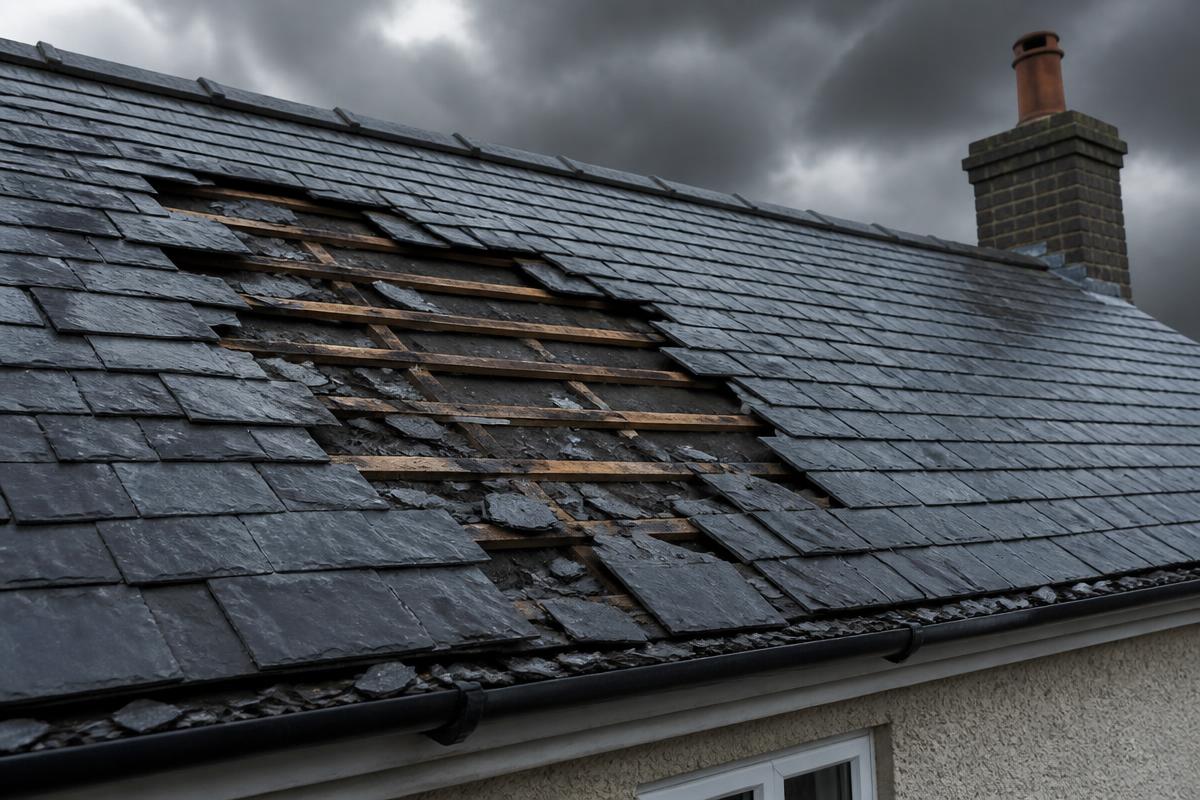
A single missing tile or slate may remain a small repair, but it exposes the roof beneath and can allow neighbouring pieces to move. The important part of the inspection is establishing whether the loss was isolated or whether nearby fixings, battens or coverings show the same deterioration.
At a glance
- One gap exposes the underlay to direct weather and ultraviolet light.
- Neighbouring pieces lose some of their restraint once one is gone.
- The cause matters: wind, a failed nail, or a decayed batten are different problems.
- Left through a winter, a small gap can become a much larger area of work.
What a single gap actually exposes
Beneath the covering there is normally an underlay, and on older properties that underlay may be a bitumen felt that has already become brittle, or there may be none at all beyond timber sarking boards. A missing slate leaves that layer taking rain and sunlight directly, and it is not designed for either on a permanent basis. A felt underlay that has gone brittle from decades of heat cycling can crack or tear within a single season of that extra exposure, turning a repair that would have taken minutes into one that involves stripping and replacing a wider area of underlay as well.
The covering also works as a system rather than as a collection of independent pieces: each tile or slate is partly held in place by the lap of the ones around and above it. Remove one and the pieces beside it lose some of that support, so they are more likely to lift or shift in the next strong wind, which is one reason a single missing slate can, over a season or two, become three or four.
Why it came off is the useful question
If the slate itself has broken — cracked across its width, perhaps from an impact or from frost getting into an existing flaw — the repair is usually straightforward: replace the piece, check the fixing is sound, and move on. If instead the fixing nail has corroded through, its neighbours were made from the same batch of nails, fixed to the same timber, on the same day, decades ago, which usually means more failures are due, not just possible, within a similar timeframe.
If the batten behind the slate has decayed — often from long-term dampness getting past an aged underlay — the new fixing has nothing sound to bite into, and simply nailing a replacement slate to a soft or crumbling batten will not hold for long. In this situation the batten itself needs attention, which may mean lifting adjacent slates to reach it.
This is why we look at the surrounding area and, where it is warranted, lift a piece to see what is behind it, rather than simply replacing what is visibly absent. A repair that only addresses the symptom on view can leave the underlying cause to produce the same failure again within a short period.
What happens if it is left
A gap left over a wet autumn and into a hard winter gives water repeated opportunities to reach timber below, and each freeze-thaw cycle on any dampened material makes further cracking more likely. It is one of the more straightforward repairs available on a pitched roof, and the cost of leaving it tends to rise faster than the cost of doing it.
What we would check
During an inspection, areas we would normally look at for this include:
- Whether the fixing failed, the material failed, or the batten failed.
- The condition of the underlay in and around the gap.
- Neighbouring pieces on the same course for movement.
- The rest of the slope for the same defect appearing elsewhere.
- Whether water has already reached the loft below the gap.
Repair, replace or monitor?
Repair
One broken or displaced piece with sound fixings and battens around it.
Replace
Repeated losses across a slope, brittle underlay and corroded fixings together indicate the slope, not the piece, is the issue.
Monitor
Nothing here should simply be monitored — an open gap should be closed.
Roof photography
Related questions
Relevant services
Book a roof inspection or drone survey
Documented findings before any repair is quoted. Suitable for pre-purchase checks, storm-event assessment and inaccessible roofs.