

Reviewed by the S Reid Roofing Ltd team — last reviewed 2026-09-15
Quick answer
Drone inspection can provide detailed visual evidence of high or difficult roof areas without someone initially walking across the covering. It can help document defects, improve understanding of repair recommendations and create imagery that can be retained as part of the inspection record.
At a glance
- Multiple angles are usually easier to obtain by drone than from a ladder or roof edge.
- Imagery is retained and can be reviewed again later, unlike a verbal description.
- It reduces the need to walk a roof purely to see it.
- It works alongside, not instead of, other inspection methods where those are needed.
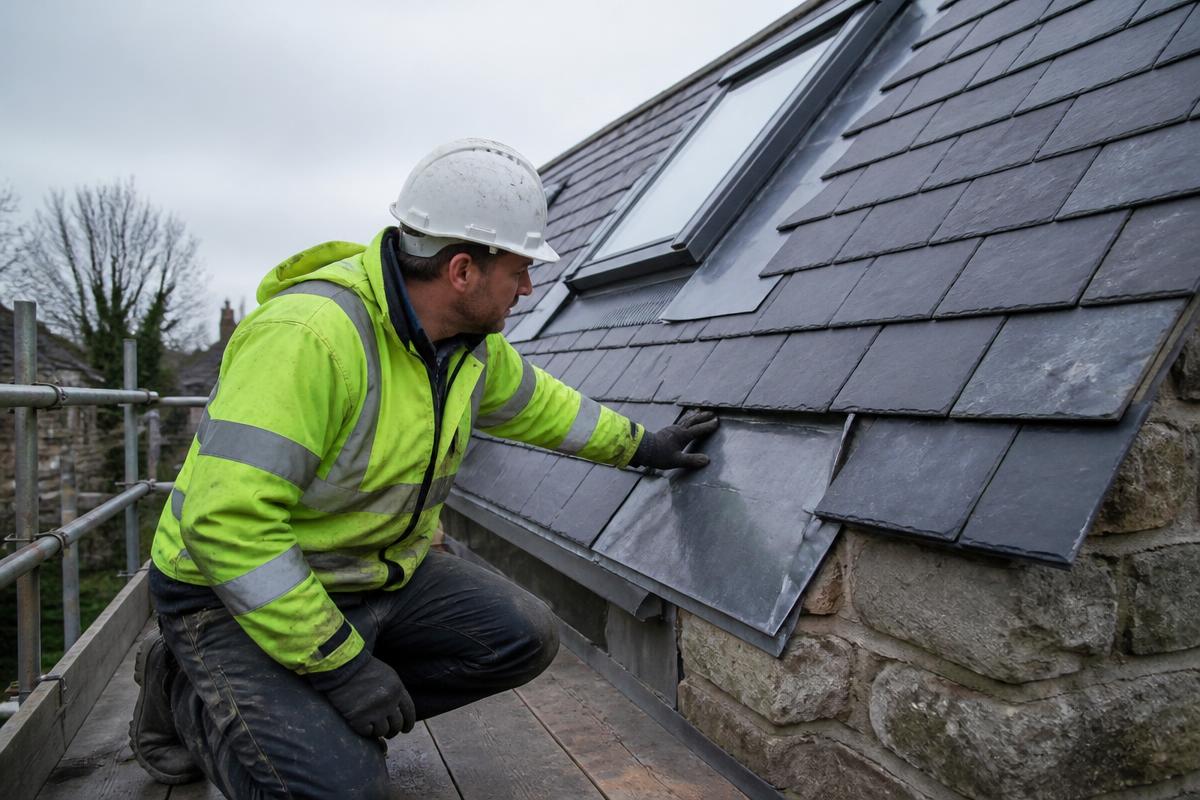
A drone survey documents what is visible: covering condition, flashings, chimneys, gutters and rainwater goods. It cannot see concealed timber decay, hidden membrane or fixing failure, every source of water ingress, or confirm structural adequacy — where those are suspected, a hands-on inspection is recommended alongside the imagery.
Better visual evidence, more easily obtained
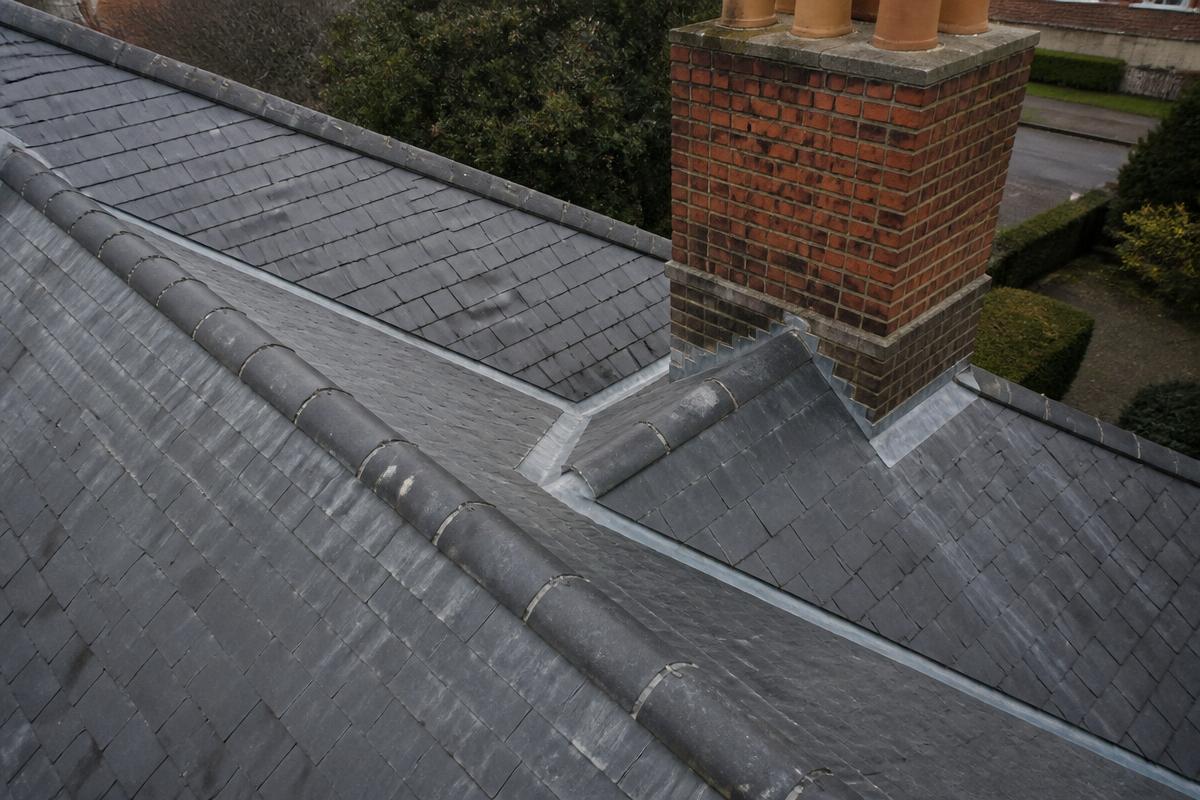
A drone can capture close, well-lit images of ridges, valleys, chimneys, flashings and roof slopes from angles that are difficult to achieve safely from a ladder or by standing at the roof edge. This is particularly useful on steep, high or complex roofs where a full walked inspection would otherwise be the only way to see some details.
Because the images are recorded rather than only described, they can be reviewed again, compared to earlier images over time, and referred to when discussing findings with a homeowner.
What it does not replace
Drone imagery shows what a camera can see from the air. It does not tell you what condition the timber, fixings or membrane are in beneath the visible surface, and it will not confirm a concealed defect. Where a problem is suspected to be hidden, a drone survey is the useful first step, not the final word.
Practical scenarios where it helps most
Drone imagery tends to add the most value on roofs that are tall, steeply pitched, have multiple levels, or sit above features such as conservatories and extensions that make ladder access awkward or unsafe. It is also useful simply to check a large roof quickly before deciding whether closer access is worth arranging at all.
For straightforward, low, easily viewed roofs, the benefit is smaller, since much of what a drone would show can already be seen adequately from the ground or a stable ladder position.
Presenting the imagery usefully
Raw photographs are only as useful as the explanation that accompanies them. Good practice is to label images by location and defect, note the apparent severity of each, and set out clearly which findings are confirmed and which are suspected but would benefit from a closer or internal check.
This turns a set of aerial photographs into something a homeowner can actually use to make a decision, rather than a folder of images without context.
Matching the method to the property, not the marketing
A homeowner considering a drone inspection should ask what specifically it will help establish for their roof, rather than assuming it is automatically the best method for every situation. On a straightforward, low bungalow roof, a ground-level check by an experienced roofer may answer the question just as well and more quickly.
What we would check
During an inspection, areas we would normally look at for this include:
- Coverings, ridges, valleys and verges across every accessible slope.
- Chimney flashings, pointing and flaunching from multiple angles.
- Guttering, downpipes and roofline details.
- Whether anything seen warrants closer, hands-on investigation.
Roof photography
Related questions
Relevant services
Book a Drone Inspection
High-resolution imagery of the covering, flashings, chimneys and rainwater goods, with documented findings before any work is recommended.