

Reviewed by the S Reid Roofing Ltd team — last reviewed 2026-09-15
Quick answer
Drone images can document visible damage and roof condition, which may be useful when explaining a storm event or repair requirement. The insurer decides whether a claim is covered, so imagery should be treated as supporting evidence rather than proof that a claim will succeed.
At a glance
- Dated, clear imagery is more useful to an insurer than a description alone.
- Cover decisions are made by the insurer against the policy terms, not by the roofer.
- Imagery works best alongside a written account of what was found and when.
- It cannot show pre-existing condition unless earlier images already exist for comparison.
A drone survey documents what is visible: covering condition, flashings, chimneys, gutters and rainwater goods. It cannot see concealed timber decay, hidden membrane or fixing failure, every source of water ingress, or confirm structural adequacy — where those are suspected, a hands-on inspection is recommended alongside the imagery.
What the imagery can contribute
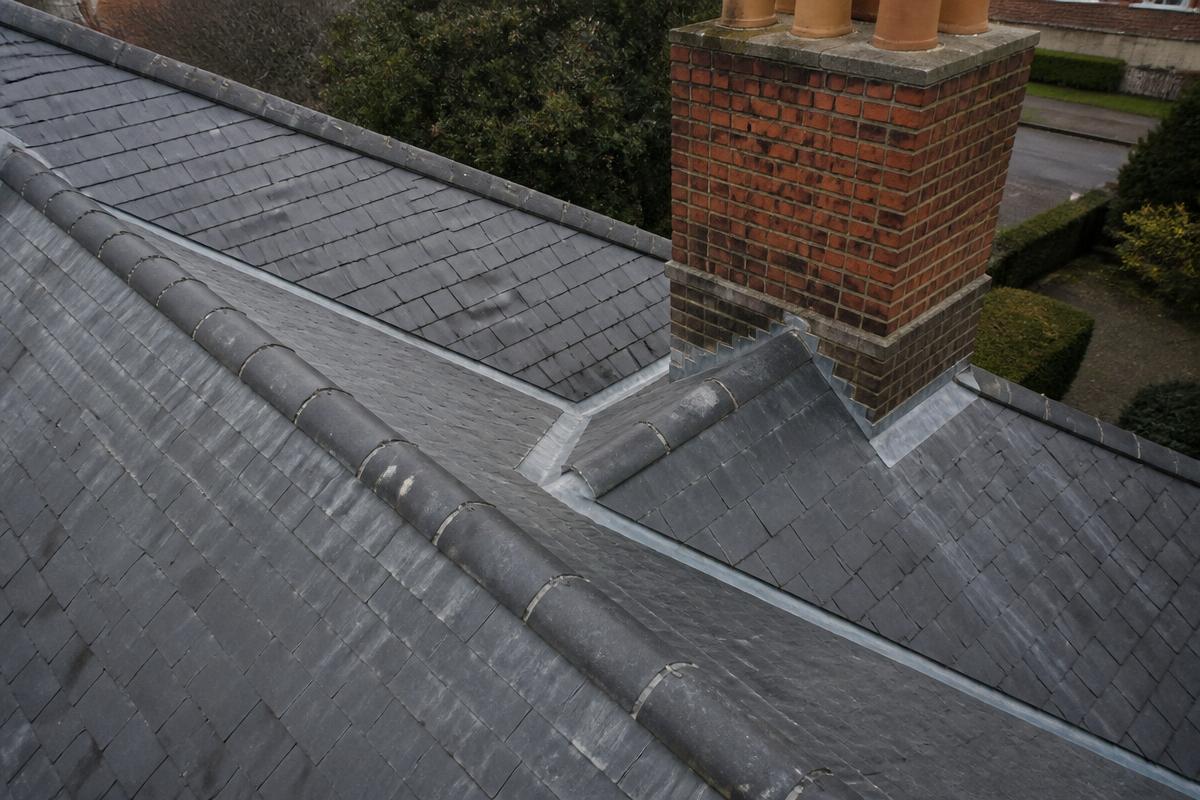
Photographs of visible damage — displaced coverings, cracked flashings, a fallen chimney pot, damaged trims on a flat roof — give an insurer something concrete to assess rather than relying only on a homeowner's description over the phone. Drone images can also show the wider context, such as whether damage is confined to one small area or spread across the roof, which can be relevant to how an event is assessed.
What it does not decide
Whether a claim is accepted, and what it covers, is a decision for the insurer based on the policy and their own assessment process. Imagery supports that process by giving clear evidence of condition at a point in time; it does not itself determine cause, pre-existing condition, or eligibility. Where a claim depends on comparing before-and-after condition, that is easier if earlier documentation already exists.
Making imagery genuinely useful to an insurer
Insurers generally respond better to imagery that is dated, includes reference points such as chimneys or roof edges to show location, and is accompanied by a short written account of what is shown and when the damage is believed to have occurred, than to isolated close-up photographs with no context.
Keeping expectations realistic
Even strong imagery cannot guarantee a particular claim outcome, since insurers assess claims against policy wording, excess levels and their own inspection where applicable. Homeowners are best served by treating drone photographs as one piece of supporting evidence to submit alongside, not instead of, the insurer's own claims process.
Retaining imagery even if a claim is not pursued immediately
It is worth keeping drone imagery and any accompanying notes even where a claim is not made straight away, since a decision on whether to claim can sometimes be made later, and having a dated record from close to the event remains useful evidence at that point.
Where imagery alone will not satisfy an insurer
Some claims turn on questions a drone photograph cannot answer, such as whether water has already tracked into ceiling joists, whether insulation has been saturated, or whether a fixing failure is due to age rather than the storm being claimed for. An insurer may ask for an internal inspection, a moisture reading, or a written engineer's opinion in these cases, and drone imagery on its own will not substitute for that further evidence.
Homeowners are better prepared for a claim if they treat the aerial photographs as the starting point for the conversation with their insurer, and expect that a policy assessor may still want to see internal evidence, particularly where the claim involves a leak rather than purely external, visible damage.
What we would check
During an inspection, areas we would normally look at for this include:
- The full extent of visible damage across the roof, not just the reported area.
- Whether the damage pattern is consistent with the reported event.
- Areas relevant to drainage or further water ingress if left unrepaired.
- What written detail should accompany the images for clarity.
Roof photography
Related questions
Relevant services
Book a Drone Inspection
High-resolution imagery of the covering, flashings, chimneys and rainwater goods, with documented findings before any work is recommended.